Seeing bobbin thread on top of your embroidery design is one of the most frustrating machine embroidery problems.
Instead of clean, balanced stitches, you get messy lines, uneven tension, and a design that looks “off.”
The good news? In most cases, this issue is completely fixable once you understand what’s causing it.
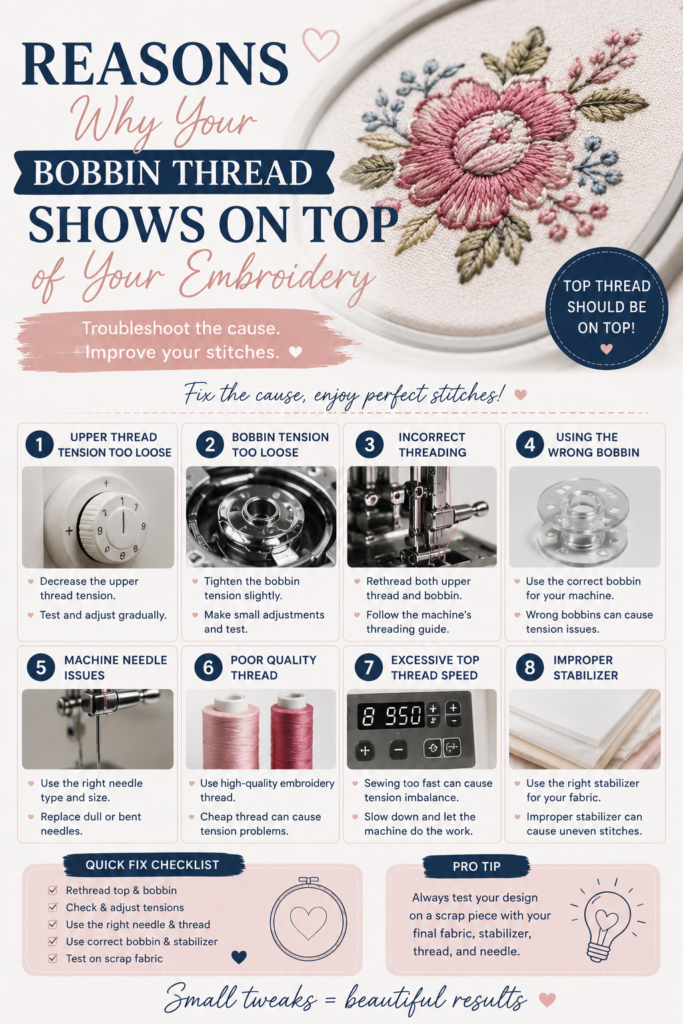
This guide explains the main reasons why bobbin thread shows on top of your embroidery and how to solve each one step by step.
What Does Bobbin Thread Showing on Top Mean?
In a properly balanced embroidery stitch:
- Top thread should dominate the design
- Bobbin thread should stay hidden underneath
If bobbin thread appears on top, it usually means tension is unbalanced or threading is incorrect.
1. Incorrect Upper Thread Tension
This is the most common cause.
What happens:
Upper thread is too loose, so bobbin thread pulls upward.
Signs:
- Bobbin thread visible on top
- Weak, messy stitches
- Uneven design appearance
Fix:
- Gradually increase upper thread tension
- Test after small adjustments
- Avoid sudden large changes
👉 Small adjustments make a big difference.
2. Bobbin Tension Too Tight or Too Loose
Bobbin tension also plays a key role.
If bobbin tension is too loose:
- Thread rises to the top
If too tight:
- Thread issues and distortion may appear
Fix:
- Check bobbin case for lint
- Adjust screw slightly (if applicable)
- Use pre-wound bobbins for consistency
3. Improper Threading of the Machine
A surprisingly common issue.
What happens:
Thread is not seated correctly in tension discs.
Fix:
- Re-thread machine completely
- Make sure presser foot is up when threading
- Follow full thread path carefully
👉 Re-threading often solves the problem instantly.
4. Wrong Needle Type or Size
A wrong needle affects stitch balance.
Problems caused:
- Skipped stitches
- Thread imbalance
- Fabric distortion
Fix:
- Use 75/11 embroidery needle (standard)
- Switch to 90/14 for thick fabrics
- Replace dull needles regularly
5. Poor Quality Thread
Cheap thread can disrupt tension balance.
Issues:
- Inconsistent thickness
- Excess lint
- Breakage and looping
Fix:
- Use high-quality polyester embroidery thread
- Avoid old or damaged thread spools
6. Incorrect Stabilizer Choice
Stabilizer supports fabric during stitching.
If too weak:
- Fabric moves
- Stitch balance shifts
Fix:
- Use cut-away for stretchy fabrics
- Use tear-away for stable fabrics
- Add extra layers for dense designs
7. Fabric Not Hooped Properly
Loose or overstretched fabric affects stitch formation.
Common mistakes:
- Fabric shifting in hoop
- Over-tight hooping
Fix:
- Hoop fabric evenly like a drum
- Ensure no wrinkles or slack areas
- Use floating method if needed
8. Machine Needs Cleaning
Lint buildup can affect thread movement.
Areas to clean:
- Bobbin case
- Needle plate
- Thread path
Fix:
- Clean after every few projects
- Use soft brush or lint tool
9. Machine Speed Too High
High speed increases tension imbalance.
Fix:
- Slow down embroidery speed
- Improve stitch control
- Reduce thread stress
10. Worn or Damaged Bobbin Case
Sometimes the issue is mechanical.
Signs:
- Constant tension problems
- Inconsistent stitching
Fix:
- Inspect bobbin case for scratches
- Replace if worn or damaged
Quick Troubleshooting Checklist
If bobbin thread shows on top, check in this order:
- Re-thread machine
- Check upper tension
- Inspect bobbin tension
- Change needle
- Check stabilizer
- Re-hoop fabric
- Clean machine
👉 Most issues are solved in the first three steps.
Pro Tips to Prevent the Problem
✔ Always test stitch before final embroidery
✔ Use consistent thread brands
✔ Change needles regularly
✔ Clean machine frequently
✔ Avoid rushing speed settings
Final Thought
When bobbin thread shows on top of embroidery, it looks like a major machine failure—but in reality, it’s usually just a small imbalance.
Once you understand tension, threading, and fabric control, most embroidery problems become predictable—and easy to fix before they even start.